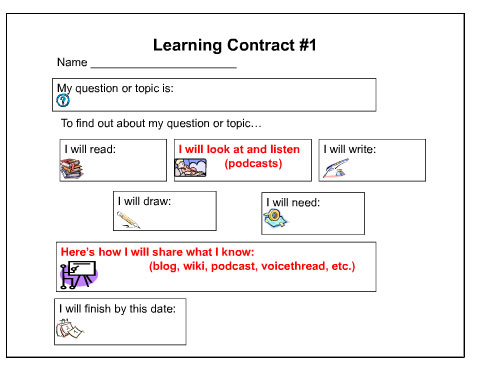
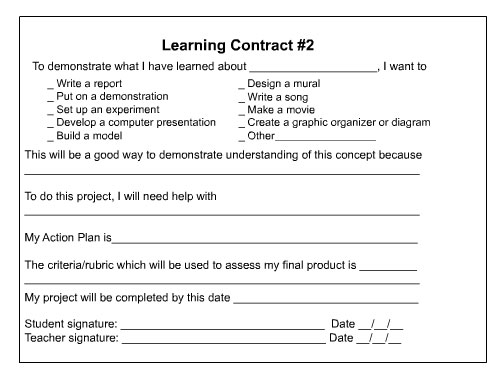
There are a number of frameworks for providing choice opportunities for students ranging from choice boards, menus and negotiables.
Teacher Toolbox
Includes detailed information and instructional strategies to
promote the academic, social, and behavioral success of students in the
classroom environment.
With Choice boards assignments are placed in a matrix. Students make a
selection from a row. The teacher targets assignments to student needs
like learning styles or interests. Teacher's Guide to Digital Choice Boards
Create a Weekly "Must Do" and "May Do" List
Give a classroom of students an array of different, personalized tasks to do, and they'll inevitably finish them at different times. That's a tricky part of differentiation. some teachers tackle this by assigning a weekly list of "must dos" and "may dos," so kids who finish first can always find something to do next.
- Language Arts, Science and Social Studies choice option examples Includes choice boards and menus.
- More examples containing sets of questions about setting, plot, types of literature, science, social studies, reading attitudes and more that can be used in a tic-tac-toe format. click here
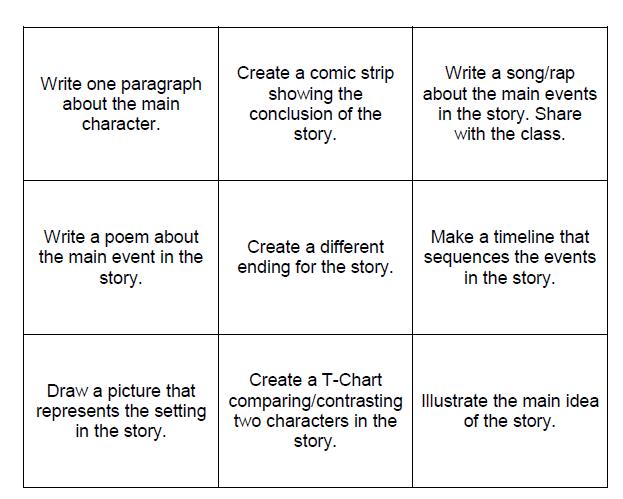
Tic-tac-toe Choice template, see examples below:
Implementation Examples
Tic-Tac-Toe Book Report
Using the Tic-Tac-Toe model, students are given choices on how to present their book report. This can be adapted to any grade level. The same TTT format is used for each book report but the students must pick a different style of activity each report. Some examples of activities included: Dioramas, mobiles, acting out a scene from the book, changing the ending, comic strips, story mapping on cubes, cereal boxes or paper sandwiches. For older students options could include i-Movies, comic life, Inspiration/ Kidspiration. The TTT model should include several options for each style of learner.- Novel tic-tac-toe example
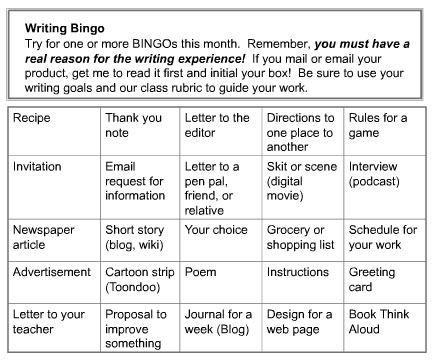
Menu of Choices
In this format, students make decisions on what they will do to meet the requirements of a lesson or unit of study. Example
Science: The Environment - Elementary
All items in the main idea and the specified number of supporting details must be completed by the due date. Select at least one from the supporting details. The extension is optional.
Main Idea: Select a problem in the ecosystem. Define and describe the difficulty it presents. (Choose one)

Supporting Details: (Choose 1)
Extension (optional)
b. If you lived in the affected area, illustrate and explain how your life would be different.
SCIENCE: AGENDA ON THE ENVIRONMENT (SECONDARY)
IMPERATIVES – Must do this
1. Select a problem in the ecosystem. Define and describe the difficulty it presents. (Choose one)
3. Develop a thesis that details past / present solutions and what you propose as future solutions.
NEGOTIABLES – You must do at least one of these.
1. Using a graphic organizer develop a timeline for when the problem started – include specific dates, events and factors that contributed to the problem and explain what the problem would look like if nothing is done.
2. Discuss the costs to the economy. Include economic, human, and environmental costs. Estimate the monetary cost and explain how you determined the total
3. Put a human face on the problem. Discuss in detail how a family’s life has been affected, based on scientific facts and economic data.
OPTIONS – You may do one or more of these.
1. Write a letter to the editor of the local newspaper commenting on the issue.
2. Create a public service announcement, with graphics to encourage public awareness.
3. Design a poster to “wake up” public servants as to the gravity of the problem.

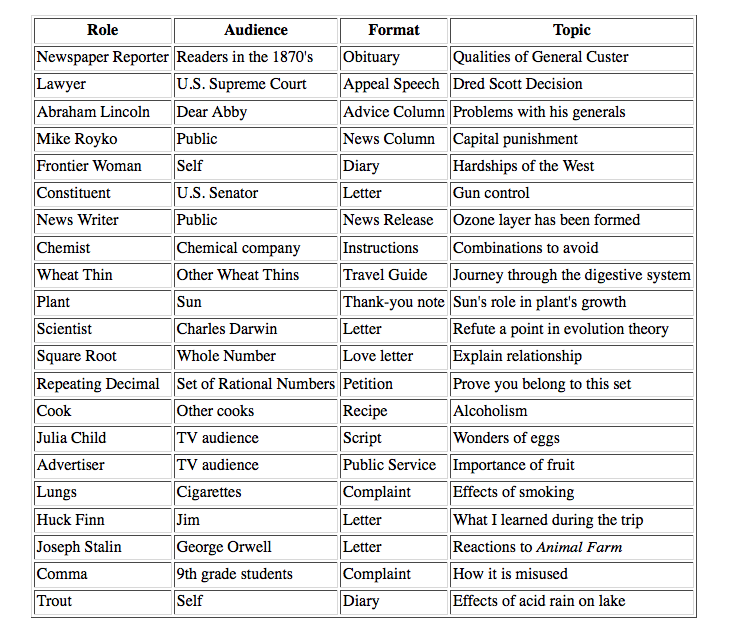
What is it?
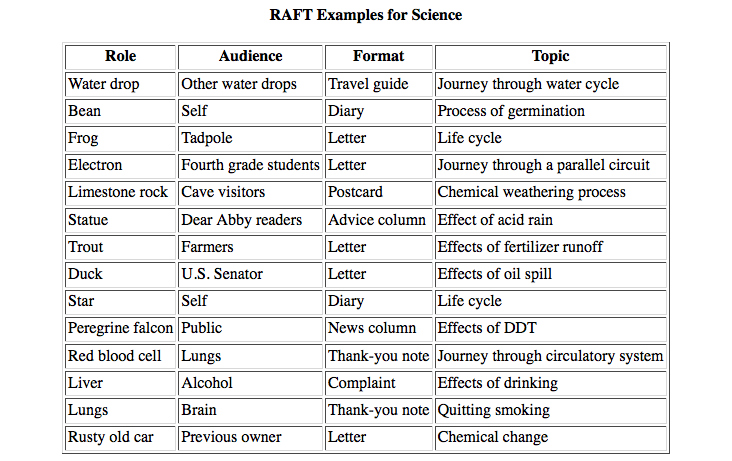
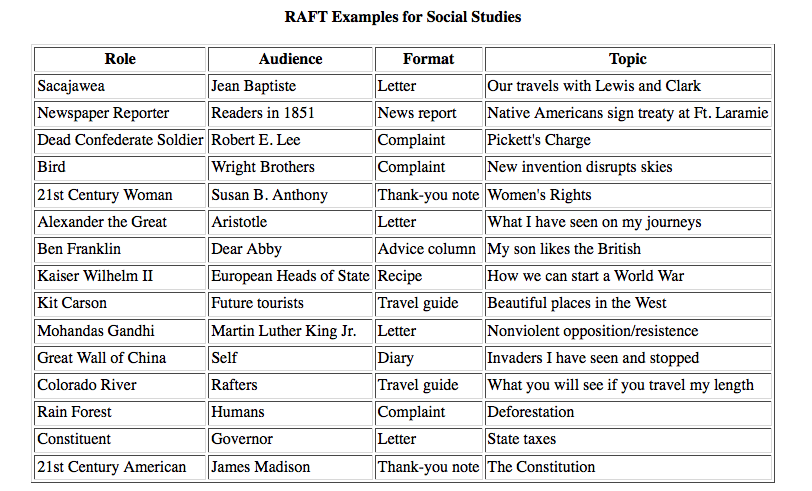
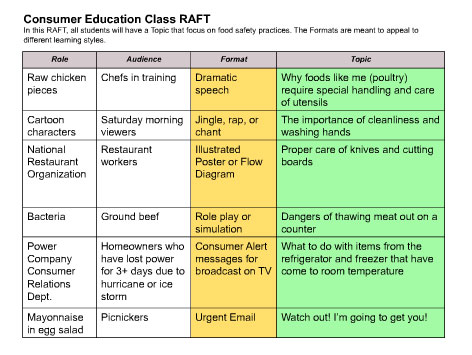
The RAFT strategy employs writing-to-learn activities to enhance understanding of informational text. Instead of writing a traditional essay explaining a concept students demonstrate their understanding in a nontraditional format. This technique encourages creative thinking and motivates students to reflect in unusual ways about concepts they have read. RAFT is an acronym that stands for :
- Role of the writer: What is the writer's role: reporter, observer, eyewitness, object, number,etc.?
- Audience: Who will be reading the writing: the teacher, other students, a parent, editor, people in the community, etc.?
- Format: What is the best way to present this writing: in a letter, an article, a report, a poem, an advertisement, e-mail, etc.?
- Topic: Who or what is the subject of this writing: a famous scientist, a prehistoric cave dweller, a character from literature, a chemical element or physical object, etc.?
The RAFT strategy forces students to process information, rather than merely write out and answer questions. Students are more likely motivated to undertake the writing assignment because it addresses various learning styles.
How could it be used in instruction?
This writing-to-learn strategy engages students in explaining what they know
about a topic and elaborating on the topic in a fun way.
How to use it:
1. Think about the concepts or processes that you want students to learn as
they read a selected passage. Consider how writing in a fun way may enhance
students' understanding of the topic.
2. Brainstorm possible roles students could assume in their writing.
3. Decide who the audience would be as well as the format for writing.
4. After students have finished reading, identify the role, audience, format
and topic (RAFT) for the writing. Assign the same role for all students,
or let them choose from several different roles.
General Template - See examples below
Examples:
More below by subject areas
Language Arts


A negotiated contract between teachers and students that give students some freedom in acquiring skills and understanding that a teacher (student) deems important.
- A Skills Component
- focus is on skills-based tasks
- Assignments are based on pre-assessment of student readiness
- Students work at their own level and pace
- A Content Component
- Focus is applying extending or enriching key content (ideas, understandings)
- Assignment is based on readiness or interest
- A Time Line
- Teacher sets completion date and check-in requirements
- Students select order of work (except for required meetings and homework)
- The Agreement
- The teacher agrees to let students have freedom to plan their time
- Students agree to use the time responsibly
- Guidelines for working are spelled out
- Consequences for ineffective use of freedom are delineated
- Signature or the teacher, student and parent, if appropriate, are included
Using Contracts as an Anchor Activity
The links below show a template, based on Bloom's Taxonomy.
They may help you create your own contracts for students based on your
content area. (It is also a resource for lesson planning based on
Bloom's Taxonomy). There is an example of a contract for a 3rd
grade math class. Also you will find more examples below.
Contract Creator
Grade 3 Math Contract Example
Elementary Contract Example
Middle/High School Examplle
Check out this sampling of Enota teachers' learning contracts and related materials:
- Language Arts Assignment Sheet (download a PDF)
- Language Arts Contract (download a PDF)
- Survival Contract (download a PDF)
- Persuasive Writing Think-Tac-Toe (download a PDF)
- Science Contract (download a PDF)
- Math Extension Menu (download a PDF)
- Math Curriculum Compacting Contract (download a PDF)